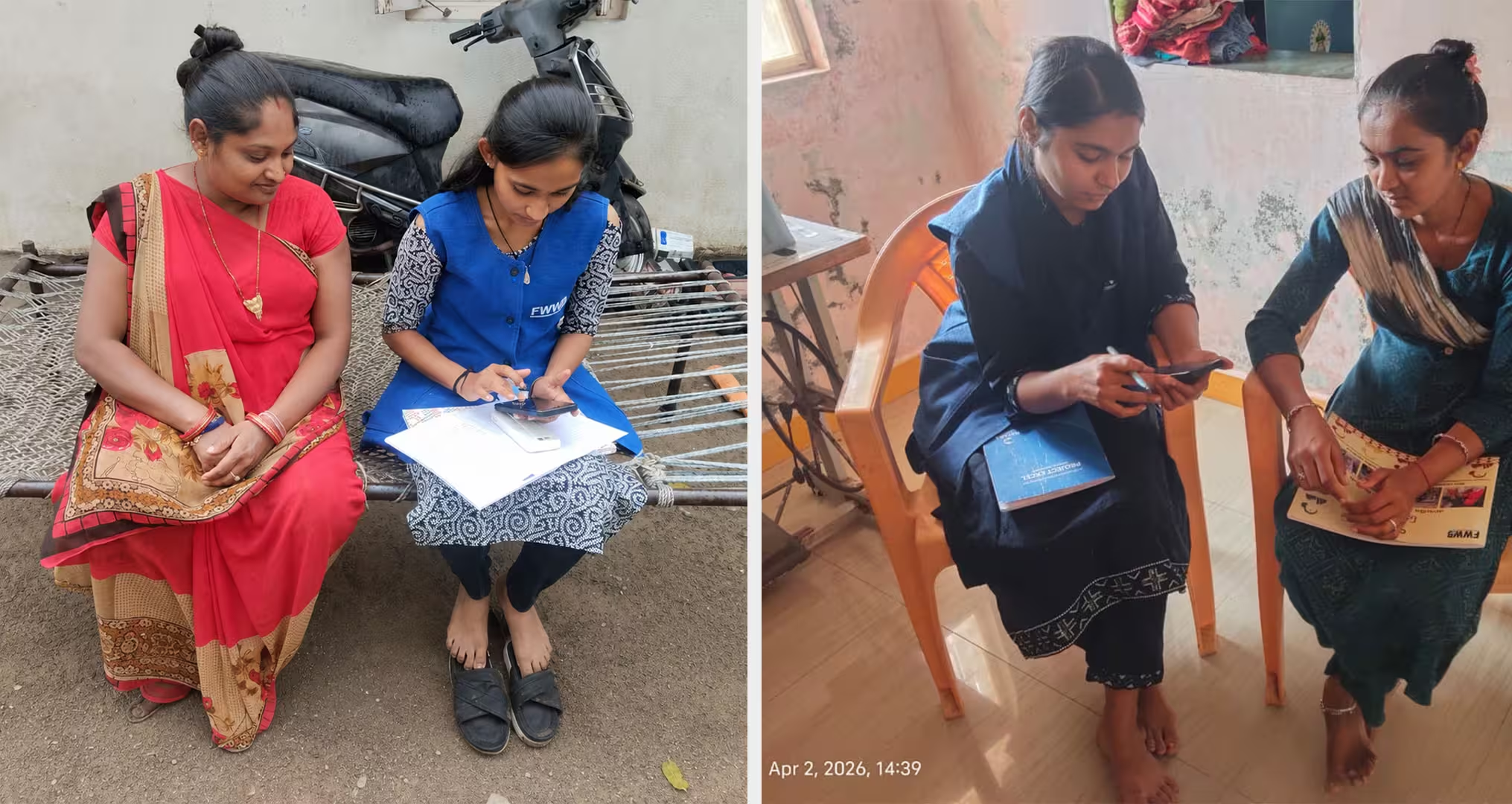

Farmer-Producer Organisations (FPOs) are widely regarded as a powerful vehicle for improving the livelihoods of small and marginal farmers. By aggregating produce, strengthening collective bargaining power and facilitating improved access to markets, FPOs can significantly enhance income stability. However, despite their potential, many early-stage FPOs struggle to transition into viable, market-oriented enterprises.
At the heart of this challenge lies access to appropriate and affordable finance across the spectrum.
Traditional agricultural lending models are rarely designed for collective rural enterprises with seasonal cash flows and limited collateral. High interest costs, rigid repayment structures, ignoring climate-related challenges, weak risk mitigation tools, and conservative lending norms create formidable barriers. When these financial constraints intersect with operational weaknesses such as limited governance capacity, an inadequate business model, inadequate infrastructure, and uncertain market access, FPOs often remain confined to low-value activities. The result is a cycle of underperformance that stifles scale, innovation, and income growth.
Blended finance offers a pathway to break this cycle.
The Structural Barriers in FPO Financing
To understand why blended finance is necessary, it is important to examine the structural challenges that constrain FPO growth.
One of the most significant limitations is inadequate infrastructure. Many FPOs lack access to modern storage, grading and processing facilities. Without appropriate drying, handling and warehousing systems, post-harvest losses remain high. This directly affects profitability and undermines efforts to secure better prices.
Market access presents another persistent difficulty. In the absence of assured offtake arrangements, FPOs frequently rely on local traders. This dependence weakens their negotiating position and exposes farmers to price volatility. Where demand is uncertain, revenue flows become unpredictable, which in turn affects repayment capacity and lender confidence.
Collateral requirements further restrict access to formal credit. Most early-stage FPOs lack sufficient tangible assets to meet conventional banking norms. Their credit histories are limited, and compliance obligations under company law frameworks can stretch managerial capacities. For financial institutions, lending to dispersed rural collectives often entails high transaction and monitoring costs. The perceived risk-to-return ratio discourages engagement.
These constraints combine to limit FPOs’ ability to aggregate effectively, invest in value addition, comply with quality standards or experiment with new business models. Without structural intervention, the financing gap persists.
A Blended Finance Approach to De-Risking FPO Lending
Recognising these challenges, FWWB developed an innovative blended finance model designed to reduce risk, lower borrowing costs, and strengthen institutional capacity simultaneously.
Rather than treating finance as a standalone product, this approach integrates concessional capital with performance incentives, technical support and structured market linkages.
A central feature of the model is a performance-linked interest subvention mechanism. Under this arrangement, FPOs receive a partial rebate on interest upon successful and timely repayment of loans. This reduces the effective cost of borrowing while encouraging financial discipline. By rewarding responsible repayment behaviour, FPOs build stronger credit histories and improve their bankability.
Concessional loans are also bundled with small grants and in-house capacity-building initiatives. The grant component serves as risk capital, enabling FPOs to invest in small-scale infrastructure, strengthen internal systems and pilot new business approaches. This combination of loan and grant reduces upfront vulnerability and creates space for controlled experimentation.
Aligning Finance with Agricultural Cash Flows
Agriculture is inherently seasonal. Cash inflows depend on harvest cycles, procurement windows and buyer payment timelines. Fixed monthly instalments often place unnecessary strain on working capital.
To address this mismatch, repayment schedules are structured around actual cash flow patterns. Instalments are aligned with procurement and harvest cycles rather than arbitrary calendar dates. Prepayment is permitted without penalty, allowing FPOs to reduce interest costs if buyer payments are received earlier than expected. The removal of processing fees further lowers the cost of accessing credit.
This farmer-sensitive design increases financial comfort and reduces repayment stress, allowing FPO leadership to focus on business planning rather than short-term liquidity pressures.
Integrating Advisory Support and Risk Mitigation
Finance alone cannot resolve governance and operational weaknesses. Accordingly, partnerships with incubators and technical service providers form an integral part of the approach.
These collaborations provide structured support in business planning, governance strengthening, quality control, crop advisory and compliance management. By improving institutional systems and operational efficiency, the credit risk associated with lending to FPOs is reduced.
An additional layer of risk mitigation is introduced through partnerships with purpose-driven social enterprises that procure directly from FPOs. In certain cases, these enterprises provide loan guarantees, assuring lenders of repayment in the event of default. This arrangement aligns incentives across stakeholders. The enterprise secures a reliable supply, the FPO benefits from predictable demand, and the lender gains enhanced risk protection.
Such structured risk-sharing mechanisms strengthen confidence throughout the value chain.
Value Chain Financing as a Strategic Lever
A defining characteristic of the model is its emphasis on Value Chain Financing (VCF). Rather than extending credit in isolation, financing is linked to confirmed market arrangements.
Loans are often backed by tie-up arrangements with pre-identified buyers for confirmed buying with prices linked to the market, reducing uncertainty and stabilising cash flows. Buyer guarantees support procurement planning and strengthens repayment capacity. Training interventions ensure quality compliance, enabling FPOs to meet institutional standards and access higher-value markets.
Investments in storage, drying, and grading infrastructure, partly funded by grants and loans, complement these financial measures. Reduced post-harvest losses, improved product handling and primary processing enhance price realisation. By embedding credit into structured marketing arrangements, the financing ecosystem becomes more reliable and less risk-averse, paving the way for a gradual flow of credit to this segment.
In this framework, finance is not merely capital—it is a catalyst integrated into the value chain.
Measurable Outcomes and Institutional Strengthening
The results of this blended and innovative finance approach have been significant.
- FPOs have gained access to affordable capital that was previously unavailable.
- Effective borrowing costs have decreased due to interest subvention and concessional terms.
- Risk-sharing arrangements have encouraged broader participation from financial institutions.
- Repayment rates have improved under performance-linked incentives, strengthening credit discipline. As FPOs build positive credit histories, mainstream banks consider them one of the potential asset classes. The availability of a guarantee from NABSARANSKSHAN to banks incentivises them to fund credit-ready FPOs curated through this model.
- Market stability has also improved. With pre-confirmed buyers and structured demand, FPOs are less dependent on local traders. Negotiation power increases, price transparency improves, and members experience more predictable income streams.
- Infrastructure investments and quality training have facilitated entry into premium markets.
- The availability of small grants has enabled experimentation with digital tools and refined business processes, fostering innovation and confidence.
Over time, these cumulative interventions support the transition of FPOs from nascent collectives into structured, market and credit-ready enterprises.
Conclusion: Rethinking Agricultural Finance for Collective Enterprises
The experience demonstrates that strengthening FPOs requires more than a conventional credit structure. Agricultural finance systems must evolve to address systemic risk, infrastructure deficits, and market volatility, and build suitable mechanisms to reduce these risks by working with civil society organisations and donor communities with a structured mechanism. Blended finance structures such as seed capital, concessional loans, guarantees, revolving funds, green bonds, and FLDGs provide a practical pathway to enhance credit flow to this segment. By combining concessional capital, performance incentives, advisory services and value chain integration, it reduces lender risk while empowering farmer collectives. When finance is aligned with cash flows, supported by market assurance and complemented by institutional strengthening, FPOs are better positioned to deliver sustainable income growth.
For policymakers, development practitioners and financial institutions, the imperative is clear. Supporting FPOs’ demands for financing models that are flexible, ecosystem-driven and responsive to agricultural realities. Through structured innovation in finance, FPOs can become resilient engines of rural prosperity, capable of delivering lasting economic benefits to smallholder farmers.
Authored by:

Himanshu Vaghela
Sr. Manager
Agriculture and Climate Finance, FWWB
A Post Graduate in Social Work with more than 15 years of work experience in the sector, in 2010, he joined FWWB and has been looking after Agriculture Finance for women, strengthening the women farmers’ producers’ companies. His core focus areas are undertaking due diligence, monitoring and evaluating, value chain financing and developing the Programme’s MIS. Till now, he has assessed and monitored more than 100 institutions working in the agriculture and microfinance domains.
Edited by:

Abhilasha Hazarika
Communication Officer, FWWB
Abhilasha is a Communications Officer at FWWB, supporting strategic communications and digital outreach. She works with internal teams, leadership, and external partners to develop content across written, graphic, and audiovisual formats. Her role includes media coordination, quality control of collaterals, and documentation of Programmemes and impact stories. Abhilasha is a graduate of the MASC Programmeme at IIT Gandhinagar, with a strong interest in social media and communications.