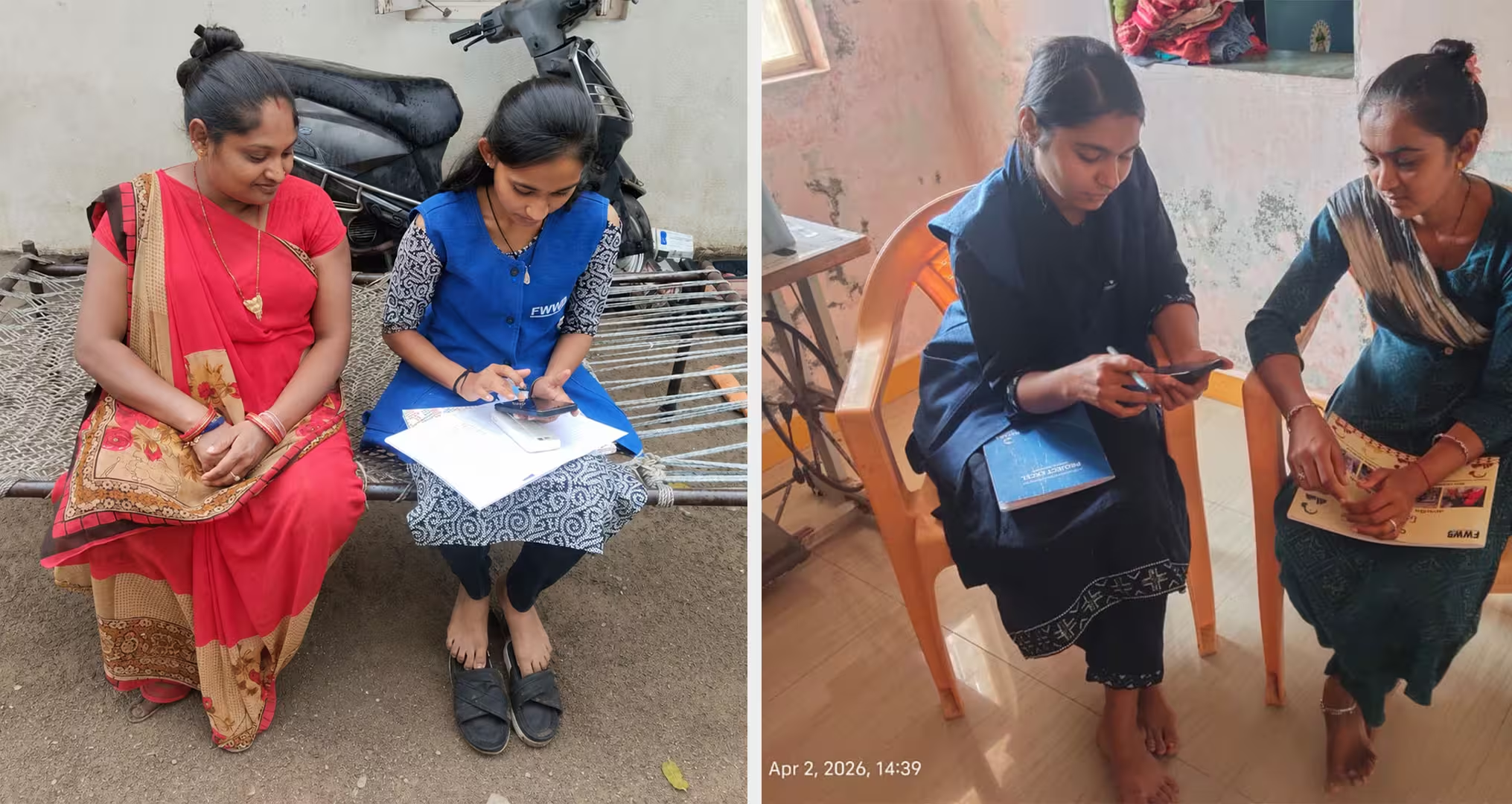
Field-based organisations, from large international NGOs to grassroots institutions, are replacing clipboards and paper forms with mobile platforms that let frontline workers capture and submit data in real time. What was once a slow chain of handwritten forms, physical transport, and manual entry is becoming a single, immediate step.
This shift matters most where field operations span multiple geographies, cohorts, and reporting cycles. For e.g. if data arrives late, errors accumulate silently, and decision-makers act on information collected weeks earlier. This challenge is especially acute for organisations with wide field coverage and dispersed communities. While paper forms require minimal initial effort, they ultimately create high long-term costs through manual administrative labour, data-entry errors, and reporting bottlenecks (ICTworks, 2020).
Nowadays, modern mobile data platforms provide specific technical capabilities that fundamentally transform field operations, particularly in remote or challenging environments:
- Reliable Offline Functionality: Because field workers frequently operate in areas with weak or non-existent cellular coverage, robust mobile platforms rely on offline-first architectures. These systems store data locally and automatically sync to the cloud once a network connection is re-established.
- Automated GPS and Spatial Verification: Unlike paper forms that rely on self-reported locations, which are highly prone to human error or fabrication, mobile devices automatically capture precise satellite coordinates at the moment of entry. Comparative field research published on PMC (2018) underscores that automated GPS tracking provides managers with indisputable, verifiable proof of field coverage and precise mapping.
- Built-in Data Validation: Digital forms utilise real-time logic constraints, such as mandatory fields, skip logic, and predefined numerical ranges. Sector data confirms that these automated filters eliminate input errors directly at the source, preventing discrepancies from ever reaching the central database.
- Rich Media Capture: Frontline staff can embed photos, audio recordings, and barcode scans directly into a digital report. Practitioners at Data for Development emphasise that capturing multimedia assets adds a layer of rich, verifiable context and fraud prevention that text alone cannot replicate.
- Instantaneous Analytics and Dashboards: Lastly, since data is transmitted immediately upon connection, headquarters can view live, aggregate data via web dashboards. This capability shifts management from a reactive posture to a proactive one, allowing leadership to make rapid, evidence-based resource allocations and decision-making.
Also, A specific study in NPJ Digital Medicine found mobile data collection tools cut collection time by nearly 1.5x and reduced average error-resolution time from four weeks on paper to three days on mobile (Taber et al., 2020, JMIR). A Mumbai-based comparative study similarly found digital tools more time-efficient and equally reliable, while lowering data management costs over time (Taber et al., 2020, JMIR).
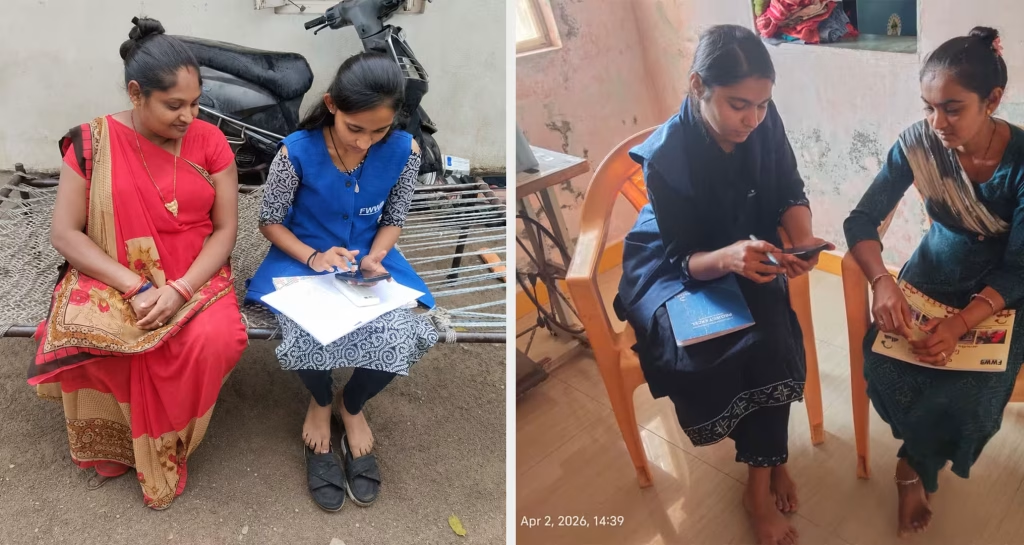
Against this backdrop, FWWB’s M&E department shifted its field data collection to mWater, a free, cloud-based platform, replacing a paper-based process to a tech-based process. The transition delivered real gains and real lessons, both explored below.
Why the Move to Mobile Data Collection Matters
For FWWB, choosing mWater came down to two factors: no licensing fees, freeing resources for staff training, form development, and system design; and offline capability, essential given the intermittent connectivity in many programme locations, with forms syncing automatically once connectivity returned.
Selecting the right platform was only the first step, though. Digital transformation depends as much on how a tool integrates into day-to-day operations as on its technical capabilities, so that benefits emerge through careful planning and continuous learning, not automatically.
What the Transition Looks Like on the Ground
The shift covered three core activities: baseline surveys at programme entry, endline assessment and monthly activity tracking. Previously, each produced paper forms or register entries that had to be transported to the office before the team could enter, review, and analyse them days after collection. Manual entry has now been eliminated entirely.
Before deployment, the M&E team ran structured training on form navigation, offline capture, and device troubleshooting, since moving from paper to mobile is a change in daily routine, not just tools.
Even so, the early weeks brought friction: duplicate entries when officers weren’t sure a form had gone through, struggles with camera/GPS permission settings, and forgotten passwords causing small delays. These were manageable, but real.
Field staff highlighted benefits beyond organisational efficiency. Carrying a single device instead of multiple paper questionnaires made fieldwork more organised, especially across several project-related visits in a day. Guided navigation and response review made interviews more structured, letting officers focus on respondents rather than checking pages for skipped or inconsistent entries. Using a digital platform during interviews felt unfamiliar at first, but became routine with repeated use; new tools take hold only once staff have practised them enough to build genuine confidence.
Time: Closing the Gap Between Collection and Use
Before the transition, travel times and review backlogs meant survey data took days to register, creating a gap between field reality and operational responses. Today, eliminating physical data transit has instantly shrunk turnaround times, making submissions visible the exact same day they are gathered.
That said, building consistent field habits took more than initial orientation. Some officers needed repeated practice before matching the confidence and rigour they had on paper. Short refresher sessions, especially after form updates, have been key to sustaining data quality beyond launch.
Accuracy: Fewer Errors, Better Data, Sharper Reviews
Removing manual entry eliminated an entire category of errors, such as misread handwriting, incorrect keyed-in figures, and duplicate-entry inconsistencies, because the officer’s submission is the dataset.
Validation and skip logic also changed how quality control happens. On paper, a missed or inconsistent field surfaces later, discovered by someone who wasn’t present at collection. On a digital form, the same issue is flagged immediately, while the officer is still with the respondent; quality control moved from the office to the field. That said, validation rules needed careful calibration: overly strict rules frustrated officers recording genuinely complex situations, and some early forms needed revision. Form design proved iterative, not a one-time task.
Supervisory review has also shifted, from checking a batch of forms at week’s end to engaging with submissions throughout the week, more demanding, but catching issues closer to the point of collection.
Digital data quality ultimately depends on what happens before submission. Supervisors conduct field visits to verify that recorded data matches what’s actually in the enterprise, catching what no validation rule can, such as a misunderstood question or an entry that doesn’t match the respondent’s document. To formalise this, FWWB developed a Standard Operating Procedure covering accountability at every stage, from field collection to mWater entry to final submission, anchored by one firm rule: no digital entry is accepted without supporting documentation. This layer of structured accountability and source-document discipline makes the data trustworthy, not just timely.
Lessons for Organisations Planning the Transition
- Keep forms simple. Don’t simply copy complex paper forms into a digital format. Start with a simpler form and add complexity gradually as the team gets comfortable.
- Pilot before rolling out. Testing with a small group would have caught validation and usability issues earlier.
- Treat training as ongoing, not a one-time event. Form revisions, new staff, and varying device familiarity mean training must recur.
- Expect device issues early on. Issues such as low battery, permissions, or duplicate submissions can happen in the field. Keeping a simple checklist can help prevent them.
- Establish a daily submission review routine. Real-time data only helps if supervisors review it regularly, not weekly.
- Formalise the workflow, not just the tool. A digital data collection tool captures data efficiently but can’t on its own guarantee it follows the SOP; writing standards down makes expectations explicit, especially for new staff or during form revisions.
- Build supportive supervision and source-document audits into routine. Submission confirms data was entered, not that it accurately reflects what was observed; therefore, field accompaniment and cross-checks against registers and passbooks remain essential.
- Keep refining form design after launch. A short review cycle after the first few weeks, identifying fields that are consistently blank or misunderstood, improves data quality more than any amount of upfront design.
Way Forward
FWWB’s transition to mobile data collection marks an important milestone in modernising its M&E system. While the shift has significantly improved how field information is captured and managed, the journey toward a fully integrated digital ecosystem is still evolving.
Going forward, the focus is on making better use of data now available in near real time, integrating it with dashboards and routine review processes so teams can monitor implementation, identify trends, and support timely decisions across programme locations. Ultimately, the transition shows that digital data collection is more than replacing paper with mobile devices: it is an opportunity to build a more agile, evidence-informed approach to programme management.
References
Vota, W. (2020, January 31). If you are still collecting data on paper, you are wasting everyone’s time. ICTworks. https://www.ictworks.org/if-you-are-still-collecting-data-on-paper-you-are-wasting-everyones-time/
Singh, Y., Jackson, D., Bhardwaj, S., Titus, N., & Goga, A. (2019). National surveillance using mobile systems for health monitoring: Complexity, functionality and feasibility. BMC Infectious Diseases, 19(Suppl 1), 786. https://doi.org/10.1186/s12879-019-4338-z
Taber, N., Mehmood, A., Vedagiri, P., Gupta, S., Pinto, R., & Bachani, A. M. (2020). Paper versus digital data collection methods for road safety observations: Comparative efficiency analysis of cost, timeliness, reliability, and results. Journal of Medical Internet Research, 22(5), e17129. https://doi.org/10.2196/17129
Co-authored by:

Aaryan Verma
MIS and Documentation Officer, FWWB
Aaryan holds a postgraduate degree in Population Studies from IIPS, Mumbai, and works as an MIS and Data Management Officer at FWWB’s Khambhalia field office. His work spans data management, monitoring, evaluation, and reporting, focusing on strengthening data quality and streamlining reporting processes. He collaborates with field teams to develop dashboards and generate insights that support effective programme implementation. He is particularly interested in leveraging data and technology to make field-level processes more efficient and meaningful.

Banoj Kumar Mahanta
Lead M & E, FWWB
Banoj Kumar Mahanta is a development sector professional with over a decade of experience in Monitoring, Evaluation, and Learning. An MBA in Hospital and Health Management from IIHMR University, Jaipur, he leads evidence-based Programmeme design, performance management, and results tracking. He has worked extensively with government departments across Uttar Pradesh, Nagaland, and Meghalaya, supporting data systems and decision-making processes. His expertise includes large-scale surveys such as CBTS and NFHS-5, and advanced analytics using STATA, R, Power BI, and Tableau.