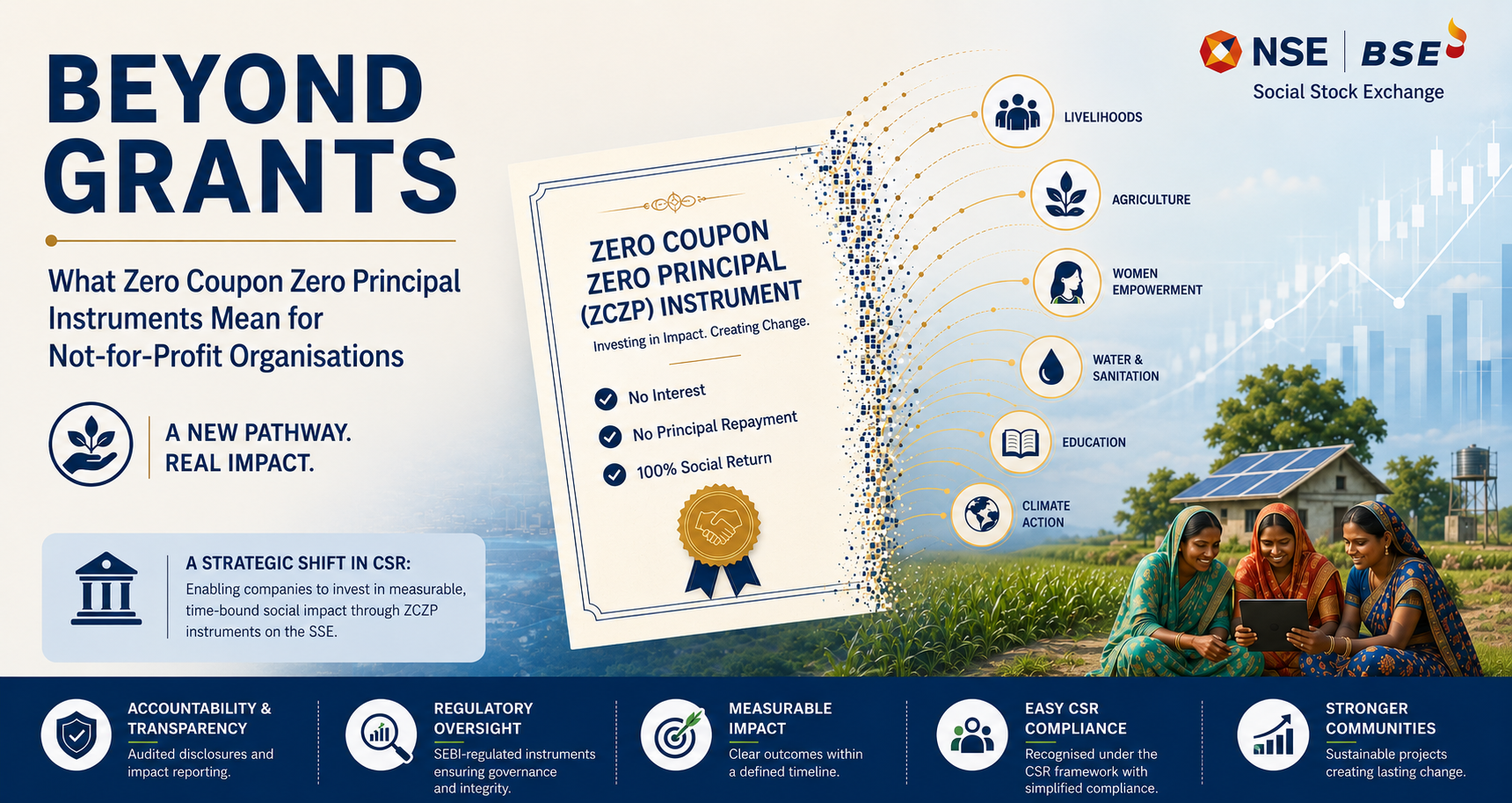
On 27 May 2026, the Ministry of Corporate Affairs rewrote a small but consequential line in India’s CSR rules. Companies can now route part of their Corporate Social Responsibility spending into Zero Coupon Zero Principal (ZCZP) instruments issued by non-profits on the Social Stock Exchange. It is the first time India’s CSR framework and its capital markets regulator, SEBI, have been formally linked, and it raises a fair question for organisations like ours: does this create genuinely new funding, or just a new form to fill in?
The honest answer is a bit of both. Here’s what the instrument is, what changed, and how it will fit into FWWB’s and other NGOs’ funding of its work.
What is a ZCZP instrument?
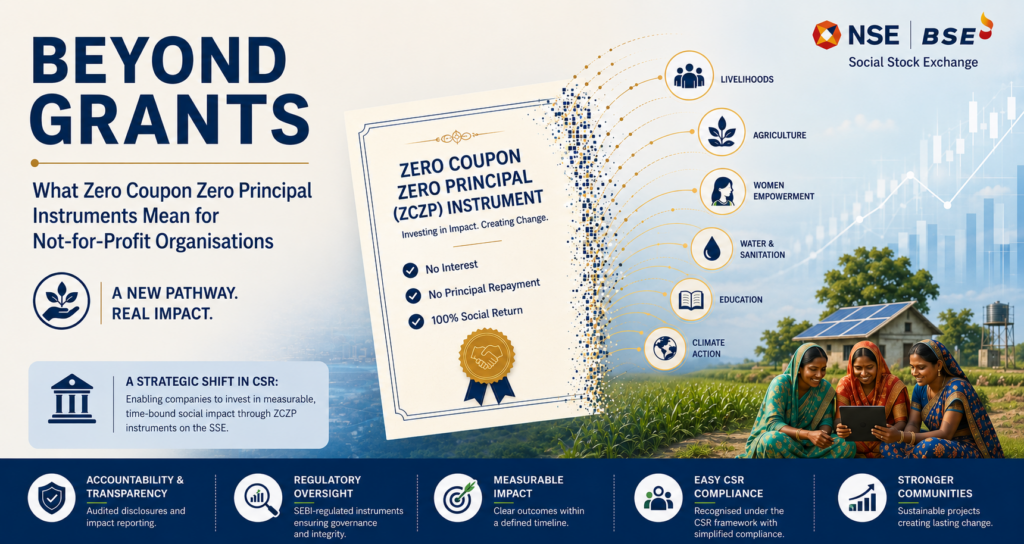
A Zero Coupon Zero Principal instrument is a regulated donation certificate. Unlike a bond, it carries no financial return: the subscriber receives no periodic interest, and at maturity, there is no repayment of the principal invested. The ‘return’ is entirely social rather than financial, which is a defined, measurable outcome delivered through a specific project, backed by formal disclosure and impact reporting.
It sits alongside grants and CSR project funding as a third route for moving capital into development work, but with one key difference: it is listed. A ZCZP instrument is issued by a Not-for-Profit Organisation registered on the SSE segment of NSE or BSE, under SEBI’s Issue of Capital and Disclosure Requirements Regulations. That listing brings market-style discipline in disclosure norms, reporting timelines, and audit requirements, to what has traditionally been a far less standardised part of NPO fundraising.
How it actually works
The mechanics are worth understanding before deciding whether this is worth pursuing:
- Registration first- An NPO has to register on the SSE segment of a recognised exchange before it can issue anything.
- Minimum issue size of ₹50 lakh, with the minimum application size recently reduced to just ₹1,000. This is a deliberate move by SEBI to broaden participation beyond large institutional donors to smaller retail contributors.
- Dematerialised and non-transferable- Instruments are held electronically and cannot be traded until maturity. There is no secondary market for them.
- A three-year clock. The funded project must be completed within three successive financial years from the date of issue. Any unspent amount at the end must be transferred to a Schedule VII fund, and the NPO must file a compliance report with SEBI.
In short, it rewards organisations that can define a project with a clear budget, timeline, and outcome, and it holds them to that definition publicly.
The real news: CSR money can now flow this way
Until this May, ZCZP was a fundraising option NPOs could explore largely on their own initiative, aimed mostly at institutional social-impact investors. The 2026 amendment changes the demand side of the equation by making it an eligible CSR activity. A few details matter here:
- A 10% cap. Companies can direct CSR spending to ZCZP instruments, but such spending cannot exceed 10% of their total CSR expenditure for the year. This is a supplementary channel, not a replacement for existing CSR budgets or grant-making.
- No separate impact assessment required. This is the detail worth underlining for anyone in a CSR-facing role: companies subscribing to ZCZP instruments are exempt from conducting their own impact assessment of the funded project. For corporations, that removes a genuine point of friction – one of the more common reasons CSR teams hesitate to fund unfamiliar organisation.
- Easier entry for NPOs. In parallel, SEBI has relaxed the framework itself – NPOs can now stay registered on the SSE for up to three years without having raised funds (up from two), and the minimum subscription threshold for a ZCZP issue has been eased from 75% to 50% for eligible projects.
- Accountability and Transparency: NPOs desirous of listing must publish audited periodic disclosures and Annual Impact Reports. Investors can track exactly how their funds are spent and the impact achieved.
- Regulatory Oversight: Being classified as securities under SEBI rules ensures strict governance and safeguards against misuse of funds.
- CSR Compliance: becomes easy as SEBI rules take care of the compliance and integrity issues.
Taken together, this is less a new pool of money and more a newly paved road between existing CSR budgets and specific, well-defined social projects. This also casts a certain responsibility on the part of the NGOs to be more transparent, systematic and compliant with the regulations, as any slip would attract a penalty from SEBI.
Where this could genuinely fit FWWB’s/NGOs’ work
FWWB or other NGOs eligible to be registered on SSE may explore subscribing to ZCZP as all activities covered under CSR schedule would be eligible for funding. The instrument is built for exactly the kind of project that has clear intent, has a defined cost, and delivers a measurable outcome within a two- to three-year window. Highly risky ones without definite outcomes, run as a proof of concept, may not be relevant for ZCZP.
The cold storage operationalisation for Giri Siri Tribal FPC and Susag Millet Sister FPC, as a part of our interventions in ASR District, is a good example to get ZCZP investments: a fixed capital asset, a clear before-and-after (reduced post-harvest loss, better price realisation for tribal farmers), and a natural completion timeline. Solar infrastructure, water and sanitation assets, or other one-time infrastructure investments tied to FPO or livelihood programmes would fit a similar profile. Livelihood and Entrepreneurship Development, Sustainable Agricultural Practices, Climate Resilient Agriculture, Solarisation, FPO Development, Women Empowerment projects developed with clear outcomes in a definite timeline are eligible to be covered under the funding route of ZCZP.
Two things make this genuinely useful for an organisation like ours, beyond the funding itself:
- A credibility signal. Getting listed requires meeting SEBI’s disclosure and governance bar – which, once cleared, becomes something NGO can point to in every donor and CSR conversation, not just ZCZP-specific ones.
- Access to smaller donors. The ₹1,000 minimum application size means a listed instrument isn’t limited to large CSR cheques; it opens the door to smaller, values-aligned individual contributors and also high net worth individuals who want to fund a specific, named project rather than give to a general fund thus the risk gets diversified.
| Some of the successful NGOs and their projects to list on SSE and raise ZCZP | ||
|---|---|---|
| Name of the NGO | Project Area | Website |
| SGBS Unnati Foundation | Youth Employability and skill training | www.unnatiblr.org |
| Swami Vivekananda(SVYM) | Tribal Healthcare and education | www.svym.org |
| Friends Engineering(FUEL) | Tech skill and career mentorship | fuelfoundation.com |
| Council for Green Revolution | Environmental and afforestation | cgrindia.org |
| MJHS Charitable Trust | Rural Development and CS | mjhsct.in |
| TRIF | Rural Livelihoods and ME | www.trif.in |
Where to be cautious
A fair assessment has to include the friction, not just the opportunity:
- Listing is real work. A draft fundraising document, SEBI-mandated disclosures, possibly a registrar and consultants. This is a heavier lift than a standard grant proposal or CSR pitch, and it assumes a level of finance and compliance capacity that not every NPO has readily available. Onboarding is more complex, expensive, and time-consuming.
- Illiquid by design. Because there’s no secondary market and no return of principal, this only appeals to donors and CSR partners already comfortable making a pure, non-recoverable social investment; it is not a substitute for financing that expects any return of capital.
- A real funding floor. The ₹50 lakh minimum issue size rules this in for a defined capital project, but rules it out for smaller pilots or exploratory work.
- Still new. The CSR-ZCZP link is barely weeks old as of this writing. Most CSR teams — and a fair number of NPOs haven’t yet become familiar with it. Early movers will likely spend real time on education before they see funding. There may be initial hesitation on the part of donors.
- A supplement, not a substitute. Given the 10% cap, no organisation should treat this as a replacement for existing grant or CSR relationships — it works best as an additional tool alongside them for the right kind of project.
- All NGOs, especially the smaller ones, will not have administrative capacity to handle the costs and compliance requirements. Ensure that it does not become a more costly exercise.
- If an NGO raises less than the required minimum 50%, the entire amount has to be refunded, and the entire exercise would be futile and can become a cost burden.
What this means, practically
For FWWB and other NGOs, the useful next step isn’t a wholesale shift in fundraising strategy; it’s an evaluation. Which one or two upcoming projects (cold storage, solar assets, WASH infrastructure, projects with definite outcomes) have the clean scope, budget, and timeline that a ZCZP issue needs?
Is there an existing CSR partner already funding similar work who might be open to this route now that the impact assessment burden on their side has been removed?
And what would it take, in terms of registration and compliance support, to get NGO SSE-registered before an actual issue arises?
None of this replaces the relationships and grants funding FWWB already relies on. But as India’s CSR ecosystem starts moving toward more market-linked, outcome-anchored instruments, organisations that understand the mechanics early and can speak to them credibly with donors will have a genuine edge in the conversations that follow.
Co-authored by:
S S Bhat
Chief Executive Officer, FWWB
S S Bhat is the Chief Executive Officer of Friends of Women’s World Banking (FWWB), India, a role he has held since 24 February 2020, leading the organization’s strategy and operations to deepen financial inclusion, women’s economic empowerment, and institutional strengthening across India. Under his leadership, FWWB continues to scale catalytic interventions that support low-income women, emerging financial institutions, and community-based organizations. In 2025, he actively participated in field engagements – in various states across India, focusing on strengthening self-help groups, federations, and convergence with government schemes to build resilient ecosystems for women entrepreneurs.

Abhilasha Hazarika
Communication Officer, FWWB
Abhilasha is a Communications Officer at FWWB, supporting strategic communications and digital outreach. She works with internal teams, leadership, and external partners to develop content across written, graphic, and audiovisual formats. Her role includes media coordination, quality control of collaterals, and documentation of Programmemes and impact stories. Abhilasha is a graduate of the MASC Programmeme at IIT Gandhinagar, with a strong interest in social media and communications.