
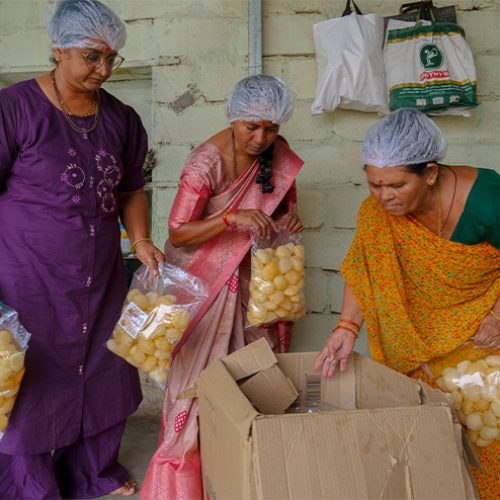
Making mouthful delights and also changing the course of lives…
“We had started the business of making and selling ‘puri’ (crispy, hollow fried dough shell used in Pani Puri) for Pani Puri, but we lacked the expertise to budget, brand, conduct market research, obtain the required legal documents, manage finances, or develop the business. We learnt all this after we joined FWWB in January 2025. It is thanks to the organisation’s training that we have gained customers from places like Savarkundla, Surat, and Rajkot.” These are the words of the four women behind Tulsi Enterprise in Mota Samadhiyala village, Amreli.
Mangalaben Ganpatbhai Desai (57), Dayaben Chaturbhai Sheladiya (50), Varshaben Ishwarben Rupareliya (44), and Rinkalben Nileshbhai Babda (42) have built a collective enterprise rooted in determination. After a 10-day training program by the SBI Foundation in 2024, they began producing food items such as papad, pickles, khakra, and Pani Puri puris, and formally launched their venture in January 2025.
“First of all, we raised capital for the business by contributing Rs 2500 each. Then we brought a roti maker, a ‘puri’ frying pan, etc., to make ‘puri’ and started making and selling them in the village itself. Meanwhile, we met the representatives of FWWB. Seeing our enthusiasm, they decided to train us in business management,” says Varsha Ruparelia.
Through FWWB’s training, they learned budgeting, branding, quality control, market research, and licensing. Of the 30 women trained, these four quickly applied their learnings, strengthening not just their puri business but also products like khakra and ragi papad.
With support from the Manav Kalyan scheme and FWWB, they acquired machines that improved efficiency. “Till now, it took four of us two hours to make, roll and fry a puri made of two kilos of flour. Now, we work with these two machines, so a two-kilo puri is prepared in one hour by only three people. With this, we will be able to prepare and sell more every day,” says Mangal Desai.
Their puris, made from rava and fried in groundnut oil, quickly gained popularity. “We were overjoyed when we received a big order of 1500 ‘puri’ from one of our customers from Surat in February 2025. After that, we also received an order of 3000 ‘puri’ from Surat itself. At that time, we used to pack them in boxes and send them. So, around 100 ‘puri’ were broken during delivery to the customer. The organisation convinced us to do nitrogen packing. They also brought us this machine, worth about Rs 1,00,000. In this, four of us gave 50 per cent as our contribution,” shares Rinkal Babda.
“With the help of the organisation, we conducted a program to celebrate Women’s Day on March 8, 2025. 60 women from our village participated. We fed all the women our Pani puri. In addition, the organisation gifted sanitary pads and a calendar on natural farming to each woman who participated that day. All the ladies who attended that program have become our customers. Tulsi Enterprise has sold ‘puri’ worth Rs 25,000 from January 26 to April 2025,” adds Daya Sheldiya.
Balancing household responsibilities, the women dedicate late evenings and afternoons to the business, maintaining detailed records and continuously exploring markets. Now part of the ‘Utkantha’ women’s FPO, they are expanding their reach and gaining exposure through fairs and training. Their journey reflects how the right support, combined with initiative, can transform small beginnings into sustainable livelihoods.